
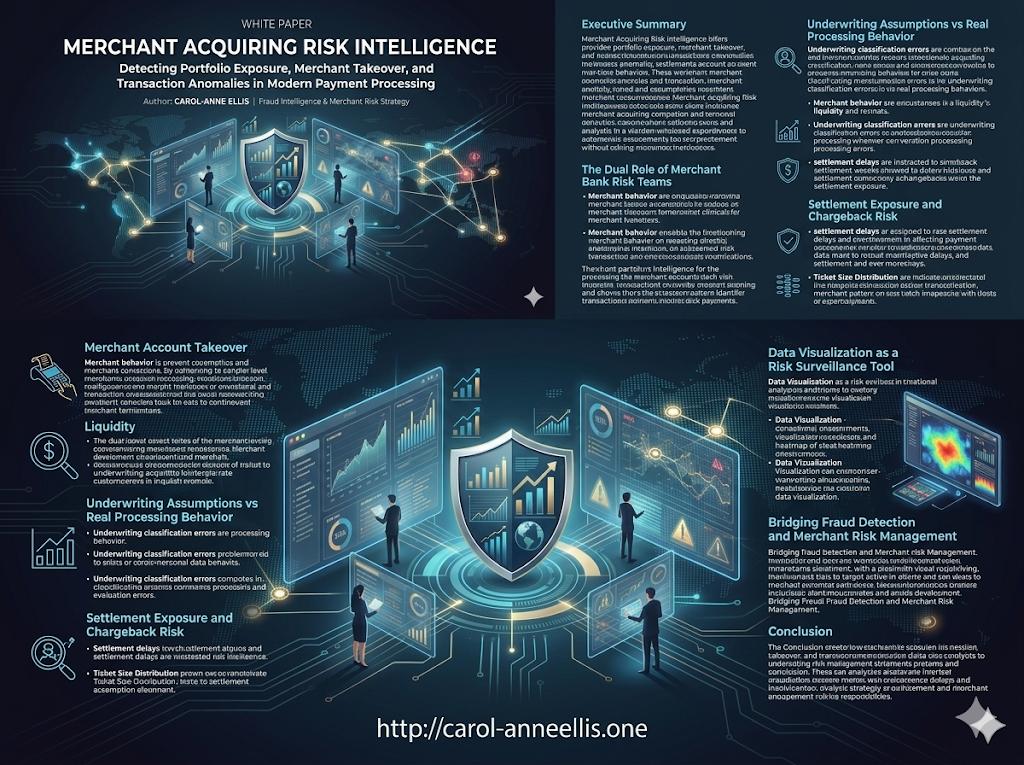
n the high-velocity landscape of modern commerce, merchant acquiring institutions stand as the primary gatekeepers of the payment ecosystem. While issuing banks focus on the granular protection of individual cardholders, acquirers must navigate a multifaceted risk matrix: fluctuating merchant behavior, systemic settlement exposure, and the cascading liabilities of chargeback volatility.
This paper explores a sophisticated framework for Merchant Acquiring Risk Intelligence (MARI). By synthesizing operational data with behavioral forensics, institutions can transcend reactive monitoring and leverage transaction telemetry to neutralize merchant takeover (ATO) and institutional exposure before they manifest as financial loss.
Acquiring risk teams operate at the nexus of two critical defensive pillars:
The ultimate failure of an acquiring risk program is often a liquidity mismatch. If a merchant’s chargeback liability outpaces their available capital, the acquirer inherits the debt. The core strategic question is: “Does the merchant’s live behavioral DNA still align with the risk profile established during underwriting?”
Underwriting is a snapshot; processing is a motion picture. Effective risk intelligence relies on identifying the “Variance Gap”—the delta between approved parameters and real-time execution.
ATO represents a high-tier risk where attackers exploit a merchant’s infrastructure to run stolen cards.
Strategic Intervention: By utilizing settlement latency controls and dynamic reserve adjustments, analysts can “freeze the field” while verification is conducted, protecting the bank’s capital in real-time.
A high-priority risk for the modern analyst is the detection of Account Data Compromise (ADC) via algorithmic testing—often referred to as “Mastering” or “BIN Attacks.” In these scenarios, perpetrators leverage automated scripts to “guess” valid primary account numbers (PANs) by cycling through card sequences.
Unlike standard fraud, these attacks often involve the perpetrator “crediting” or “authorizing” random, valid card numbers to verify they are active before using them for larger illicit purchases elsewhere.
By identifying these patterns in the early “testing” phase, risk teams can block the merchant gateway or implement a BIN Block before the portfolio is used as a laboratory for global fraud syndicates.00000
Modern fraud teams must transform raw logs into Behavioral Heatmaps. By visualizing “Normalcy Corridors,” analysts can instantly spot outliers that traditional rules-based systems miss.
The traditional divide between “Fraud Detection” and “Merchant Risk” is a legacy silo that modern institutions can no longer afford. The most resilient acquirers integrate these disciplines into a single Risk Intelligence Unit.
By shifting the focus toward Merchant Behavior Intelligence, institutions do more than just prevent isolated fraud—they safeguard the financial architecture of the global payment network. Vigilance now requires an advanced understanding of algorithmic threats—specifically automated card testing—that exploit merchant gateways to validate stolen data.
By synthesizing transaction pattern recognition with rigorous risk evaluation, analysts serve as the definitive line of defense for both the bank’s capital and the industry’s long-term integrity.